
If you’ve ever trained consistently for months and stopped seeing results, this may be why.
Not because you weren’t working hard enough.
Not because you needed a new programme.
Because you stopped progressing.
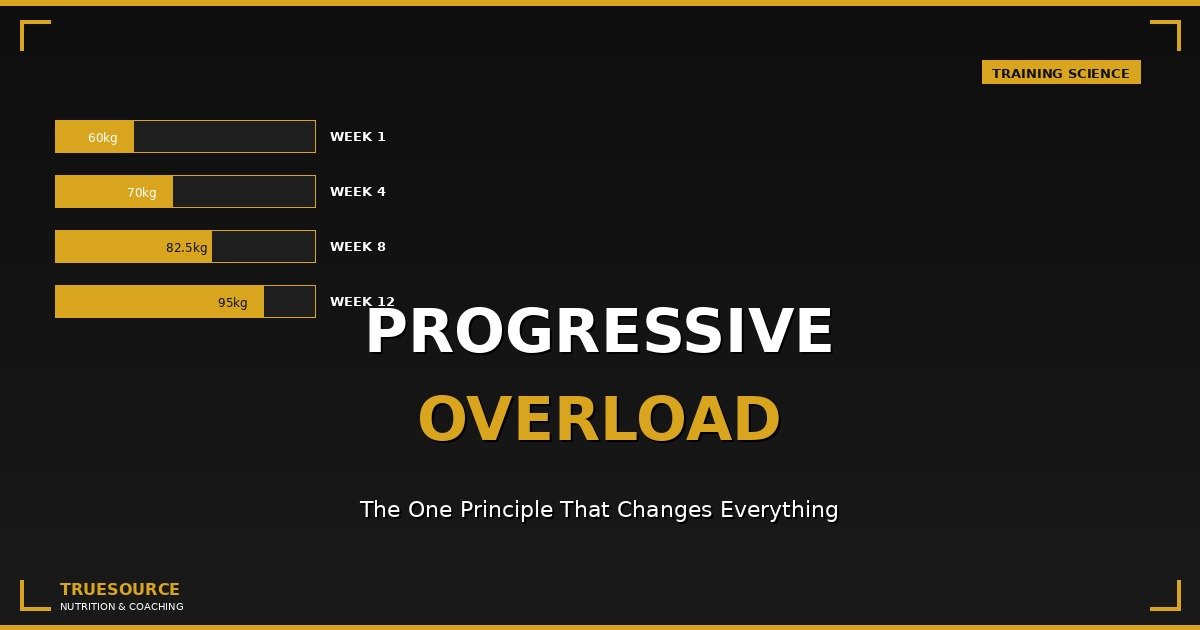
Progressive overload is the single most important principle in structured training.
Without it, the gym becomes maintenance.
With it, it becomes transformation.
What Is Progressive Overload?
Progressive overload means gradually increasing the demand placed on your body over time.
Your body is extraordinarily good at adapting.
When you perform the same workout, with the same weight, for the same reps, week after week — your body gets efficient at it.
Efficient means easier.
Easier means no new stimulus.
No stimulus means no adaptation.
No adaptation means no progress.
Progressive overload breaks this cycle by consistently giving your body a reason to improve.
Why It Works
The science is straightforward.
When you subject muscle tissue to stress beyond what it’s accustomed to, your body responds by repairing and rebuilding — stronger, denser, and more capable than before.
This process is called supercompensation.
Rest allows recovery.
Recovery allows adaptation.
Adaptation is progress.
Progressive overload ensures that each block of training builds on the last — so you’re always slightly ahead of where your body has adapted to.
The Five Ways to Progress
Most people think progressive overload means lifting heavier every week.
That’s one method. But it’s not the only one.
1. Load progression — Increase the weight when all reps are completed with correct form and sufficient reps in reserve.
2. Rep progression — Add 1–2 reps to a set before increasing load. Example: Week 1 you hit 8 reps at 60kg. Week 2 you hit 10 reps at 60kg. Week 3 you increase to 65kg and start back at 8.
3. Set progression — Add a working set to your programme. Moving from 3 to 4 sets per exercise increases total volume significantly.
4. Rest reduction — Performing the same work in less time is a form of progression. Reducing rest periods from 3 minutes to 2 minutes increases training density.
5. Tempo progression — Slowing the eccentric (lowering) phase increases time under tension without adding load. A 3-second lowering phase on a squat is meaningfully harder than a 1-second drop.
Understanding these five methods gives you multiple tools to keep making progress — even when adding weight isn’t possible.
The Role of Deload Weeks
This is where most self-programmed training fails.
More is not always better.
Adaptation doesn’t happen during the workout.
It happens during recovery.
If you push hard every single week without strategic rest, you accumulate fatigue faster than you accumulate fitness.
This is why all of our Truesource programmes include structured deload weeks — typically every 4 weeks.
During a deload, you train at roughly 60% of your previous week’s load.
This allows:
- Nervous system recovery
- Joint and connective tissue repair
- Hormonal restoration
- Mental reset
After a deload, most people return stronger — not weaker.
The deload is not a rest week.
It’s a strategic part of the progression model.
How We Build It Into Truesource
Every programme inside our platform is structured around the progressive overload principle.
Each 12-week block follows a clear pattern:
Week 1 — Establish baseline loads. Learn the movements. Build consistency.
Weeks 2–3 — Push hard. Adaptation happens here.
Week 4 — Deload. 60% load. Focus on technique and movement speed.
Weeks 5–7 — Three-week block of progressive work. Loads increase week on week.
Week 8 — Deload again.
Weeks 9–11 — Final hard block. This is where the biggest gains come.
Week 12 — Either test your progress with near-maximal effort, or use it as a final deload before beginning Block 2.
This structure isn’t arbitrary.
It’s built around how human physiology actually adapts.
The RIR System
Inside every Truesource programme you’ll see the term RIR — Reps in Reserve.
RIR tells you how close to failure to train on each set.
2 RIR means you stop the set with 2 reps still in the tank.
1 RIR means you’re one rep from failure.
0 RIR means you’ve taken the set to technical failure.
Why does this matter?
Because it regulates training intensity across different exercises and fatigue levels.
Compound movements like squats and deadlifts are trained at higher RIR to protect technique under fatigue.
Isolation movements like curls and lateral raises can be taken closer to failure safely.
RIR keeps progressive overload honest — without the injury risk of ego lifting.
Common Progressive Overload Mistakes
Adding weight too quickly — Progress should feel earned, not forced. If technique breaks down, the weight is too heavy.
Ignoring rep quality — A controlled 8-rep set drives more adaptation than a sloppy 12-rep set. Always prioritise quality over quantity.
Skipping deloads — The training is the stimulus. The deload is the adaptation. You need both.
Comparing week to week too aggressively — Progress is not always linear. Weekly fluctuations are normal. Assess across months, not days.
No record keeping — If you don’t track your weights and reps, you can’t progress systematically. Keep track.
Why This Changes Everything
Most people in a gym are doing maintenance without knowing it.
Same exercises. Same weight. Same rep ranges. Month after month.
They look the same in six months because they’ve given their body no reason to change.
Progressive overload is the difference between training and progressing.
It is not complicated.
It is not advanced.
It is simply the commitment to doing slightly more than last time — consistently, over months and years.
That’s what builds a body.
That’s what builds a habit.
That’s what builds real, lasting results.
Want a Programme Built Around This?
Every Truesource workout programme is structured around progressive overload, periodisation, and the RIR system.
Strength, hypertrophy, home-based, kettlebell, CrossFit, Olympic lifting, beginner — every category follows the same evidence-based framework.
Further reading: What happens after fat loss | Macro tracking for beginners | How to build a fat loss meal plan

One Comment