Protein is the most discussed macronutrient in fitness. It’s also the most misunderstood.
Too much and people worry about their kidneys. Too little and they lose muscle while trying to lose fat. Most people in the UK are somewhere in between — eating enough protein to survive but not enough to support the body composition they’re working toward.
This guide answers the question properly: Actually how much protein do I need per day, what the evidence says, and how to hit your targets in real life without obsessing over every meal.
What Protein Actually Does in the Body
Before the numbers, it’s worth understanding why protein matters beyond the gym.
Protein is made up of amino acids — the building blocks your body uses to repair and build tissue, produce hormones and enzymes, support immune function, and transport oxygen in the blood. It’s not just a muscle nutrient. It’s a fundamental structural component of every cell in your body.
From a body composition perspective, three things make protein particularly important:
Muscle protein synthesis — protein provides the raw material for your body to build and repair muscle tissue, especially in response to resistance training. Without sufficient protein, training stimulus produces limited adaptation.
Satiety — protein is the most satiating macronutrient, gram for gram. Higher protein intakes reduce hunger hormones and increase fullness signals, which makes maintaining a calorie deficit significantly easier without relying on willpower.
Thermic effect — your body uses approximately 20-30% of protein’s calories just to digest and process it, compared to 5-10% for carbohydrates and 0-3% for fats. This means protein contributes less net energy than its calorie count suggests.
How Much Protein Do You Actually Need Per Day in the UK?
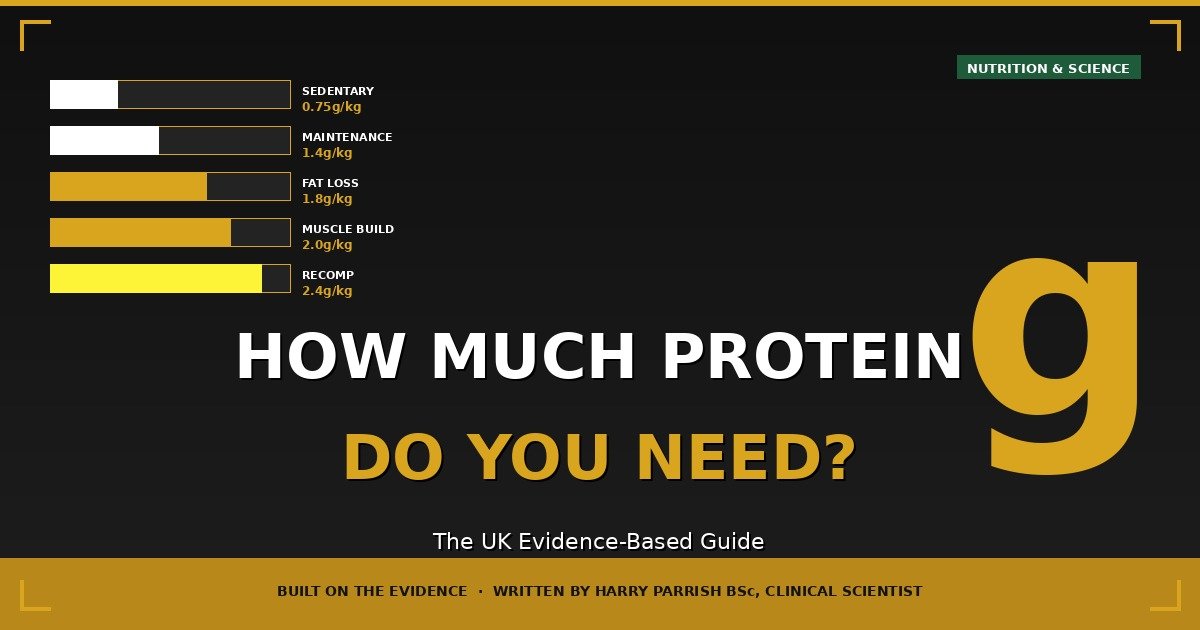
The UK government’s Reference Nutrient Intake (RNI) for protein is 0.75g per kilogram of body weight per day. This is the minimum required to prevent deficiency in a sedentary adult.
For anyone exercising regularly, building muscle, managing body composition, or trying to lose fat while preserving lean tissue — this figure is not enough.
The evidence-based range for active individuals is considerably higher.
Protein Targets by Goal
For fat loss (preserving muscle while in a calorie deficit) 1.6 to 2.4g of protein per kilogram of body weight per day.
The higher end of this range is appropriate during periods of significant calorie restriction, where the risk of muscle loss is greatest. Research consistently shows that higher protein intakes during a calorie deficit preserve significantly more lean mass than lower intakes — meaning more of what you lose is fat, not muscle.
For building muscle (in a calorie maintenance or small surplus) 1.6 to 2.2g of protein per kilogram of body weight per day.
A landmark 2017 systematic review and meta-analysis published in the British Journal of Sports Medicine, analysing 49 studies and 1,800 participants, found that protein intakes above 1.62g/kg/day produced no additional muscle growth benefit. The evidence points to this range as the practical ceiling for muscle building purposes.
For maintenance (active lifestyle, no specific physique goal) 1.2 to 1.6g of protein per kilogram of body weight per day.
This range supports muscle retention, recovery, and general health for people who exercise regularly but are not in a dedicated fat loss or muscle building phase.
Real World Examples — UK Adult Targets
| Body Weight | Fat Loss Target | Muscle Building Target | Maintenance |
|---|---|---|---|
| 60kg | 96–144g/day | 96–132g/day | 72–96g/day |
| 75kg | 120–180g/day | 120–165g/day | 90–120g/day |
| 85kg | 136–204g/day | 136–187g/day | 102–136g/day |
| 100kg | 160–240g/day | 160–220g/day | 120–160g/day |
Use the middle of the range as your starting target. Adjust after 3-4 weeks based on how you feel, how your recovery is, and whether you’re hitting your other calorie and macro targets.
Does Eating More Protein Than This Cause Any Problems?
For the overwhelming majority of healthy adults — no.
The concern about high protein intake damaging kidneys originates from research conducted on patients with existing chronic kidney disease, in whom high protein intakes can accelerate damage to already-compromised kidneys. In people with healthy kidney function, the evidence consistently shows no adverse effect from intakes well above the ranges recommended above.
A 2016 study published in the Journal of the International Society of Sports Nutrition specifically examined protein intakes of up to 4.4g/kg/day in healthy trained individuals and found no adverse health effects.
If you have been diagnosed with kidney disease or any condition affecting kidney function, you should seek specific medical advice on your protein intake. For everyone else, the practical upper limit is determined by satiety and food preference — not by health risk.
The Protein Myth Worth Addressing
“You can only absorb 20-30g of protein per meal.”
This is one of the most persistent myths in fitness nutrition and it is not supported by current evidence. Your body absorbs essentially all of the protein you eat. What varies is the rate of muscle protein synthesis stimulated by a single meal.
Research does suggest that 0.4g of protein per kilogram of body weight per meal — roughly 25-40g for most people — is sufficient to maximally stimulate muscle protein synthesis in a single sitting. Additional protein beyond this doesn’t produce more muscle synthesis in that meal.
However this does not mean excess protein is wasted — your body uses it for other purposes including gluconeogenesis, and it contributes to satiety. The practical implication is that spreading your protein across 3-4 meals rather than consuming it all in one sitting is likely to produce better muscle building outcomes — not because you “can’t absorb” more, but because you’re maximising the number of muscle protein synthesis signals throughout the day.
How to Hit Your Protein Target in Real Life
Knowing your number is straightforward. Consistently hitting it is where most people struggle — particularly on days where meal prep hasn’t happened or life gets in the way.
Here are the practical strategies that make high protein intake sustainable:
Build Every Meal Around a Protein Source
Rather than tracking at the end of the day and finding you’re 50g short at 9pm, start every meal by deciding the protein source first.
High-quality protein sources and their approximate protein content per 100g:
- Chicken breast: 31g
- Tuna (in water): 25g
- Salmon: 20g
- Eggs: 13g (approx 7g per egg)
- Greek yoghurt (plain): 10g
- Cottage cheese: 11g
- Quark: 12g
- Lean beef mince (5% fat): 23g
- Turkey mince: 24g
- Tofu (firm): 17g
- Tempeh: 19g
- Lentils (cooked): 9g
- Chickpeas (cooked): 9g
- Edamame: 11g
Don’t Neglect Protein at Breakfast
Most people eat their lowest protein meal at breakfast — toast, cereal, or a piece of fruit — then try to make up the deficit across lunch and dinner. Starting breakfast with a protein-rich option (Greek yoghurt, eggs, smoked salmon, a protein smoothie) distributes your intake more evenly and makes the daily target much easier to hit.
Track for 2-4 Weeks, Then Eat by Feel
You don’t need to track calories and protein indefinitely. Tracking consistently for a few weeks builds an accurate mental model of what different foods contain, which allows most people to eat intuitively at their targets without ongoing logging. Use a tracker to learn, not as a permanent dependency. Thats why planning proactively makes things more simple and is easier to stay on track.
Protein and Your Calorie Target — How They Work Together
Protein doesn’t exist in isolation from your other nutrition goals. Your daily calorie target determines the context — whether you’re in a deficit for fat loss, a maintenance for body recomposition, or a slight surplus for muscle building — and protein should be set within that context.
If you haven’t yet calculated your calorie targets, our free calorie calculator uses the Mifflin-St Jeor equation to give you personalised calorie and macro targets based on your weight, height, age, and activity level. Learn more about it here.
Calculate your calorie and protein targets here →
Once you have your targets, the Truesource meal planner lets you build a week of meals around your protein goal automatically — every recipe shows full macros including protein, and your daily totals calculate as you plan.
Frequently Asked Questions on Daily Protein Intake
Do I need protein shakes to hit my target? No. Whole food sources of protein are nutritionally superior and more satiating. Protein supplements are a convenient option for people who struggle to hit targets through food alone — particularly useful post-workout when appetite may be low — but they are not necessary. Food first.
Does protein timing matter — should I eat it straight after training? The post-workout “anabolic window” has been significantly overstated. Research suggests that total daily protein intake matters far more than timing. That said, consuming a protein-rich meal within 2 hours of training is sensible practice. It doesn’t need to be immediate.
Is plant-based protein as effective as animal protein? Plant proteins are generally lower in leucine — the amino acid most directly responsible for triggering muscle protein synthesis — and are less complete in their amino acid profiles. This doesn’t mean plant-based diets can’t support muscle building; it means plant-based eaters should aim for the higher end of the protein range (2.0-2.4g/kg) and prioritise leucine-rich plant sources like soy, edamame, and legumes. Combining plant protein sources across the day also improves amino acid completeness.
Will I gain fat from eating more protein? Excess calories cause fat gain — not excess protein specifically. Protein is the least likely macronutrient to be stored as fat due to its thermic effect and the metabolic cost of protein synthesis. Studies have specifically examined high protein intakes under controlled conditions and found no preferential fat gain from protein compared to equivalent calorie intakes from carbohydrates or fats.
Summary — Practical Protein Targets for UK Adults
Fat loss: 1.6–2.4g per kg of body weight per day Muscle building: 1.6–2.2g per kg of body weight per day Active maintenance: 1.2–1.6g per kg of body weight per day
Spread your intake across 3-4 meals. Build every meal around a protein source. Calculate your personalised starting point using the calorie calculator — and track consistently for 4 weeks to build your nutritional awareness.
For a structured approach to hitting your targets week after week — with 500+ macro-tracked recipes, an integrated meal planner, and nutrition tracking built in — explore the Truesource membership here.
For more on structuring your nutrition around your goals: Macro Tracking for Fat Loss | How to Build a Fat Loss Meal Plan | What Happens After Fat Loss


2 Comments